Personalized Learning Breakthroughs and Ethical Challenges That Defined the Year
Saturday, 20 December 2025, 12:58 IST
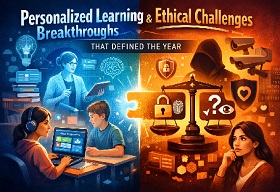
- Personalized and technology-driven learning advanced in India, with AI, flexible programs, and skill-focused initiatives reshaping education for students and professionals.
- India strengthened its global education footprint, with new international campuses, university modernization projects, and strategic partnerships to cultivate next-generation talent.
- Ethical AI and industry-aligned skill programs gained prominence, ensuring responsible innovation, equitable access, and workforce readiness alongside personalized learning breakthroughs.
The education landscape in India and globally witnessed a transformative year, marked by rapid strides in personalized learning, technological integration, and innovative skill-building initiatives. At the heart of these breakthroughs was a concerted effort to equip students and professionals with next-generation capabilities while addressing emerging ethical and policy challenges. From AI-driven programs to strategic international collaborations, the year highlighted the delicate balance between innovation and responsible implementation.
Advancing Specialized Skills: From Finance to Technology
This year, IIM Bangalore launched a certificate program for next-gen financial advisors, aimed at bridging the knowledge gap in modern financial management and advisory. By combining rigorous academic frameworks with real-world case studies, the program reflects a broader trend of professional upskilling that caters to individual learner needs. As Finance Minister Nirmala Sitharaman noted, “Skill development aligned with market demands is essential for India to retain its competitive edge globally”. In parallel, the higher education sector witnessed strategic collaborations to address the country’s growing tech talent needs. The SSAHE and upGrad partnership emerged as a landmark initiative to cultivate India’s future technology leaders through specialized courses in AI, data science, and emerging digital technologies.
These programs, designed for flexible and personalized learning, exemplify the move toward learner-centric education models. Similarly, Vishwakarma University hosted an AI Pre-Summit on Future Skills and Human Capital, underscoring the critical role of AI literacy in shaping tomorrow’s workforce. By engaging industry leaders, policymakers, and educators, the summit highlighted skill gaps, curriculum innovations, and ethical frameworks necessary for responsible AI adoption.
Also Read: 18% Hike, Zero Impact? Why GST Alone Can't Break the Coaching Habit
Building India’s Global Education Footprint
India’s aspiration to become a global education hub gained momentum with key policy calls and infrastructure investments. The Central Education Authority (CEA) urged a state-led push to establish India as a global education destination, emphasizing investment in world-class institutions, research infrastructure, and student-centric policies. Complementing this vision, UNSW Sydney announced plans to expand its global footprint with a Bengaluru campus by 2026, while Victoria University is set to open India’s first block-model campus in Gurugram, introducing a modular, student-focused approach to learning.
On the national front, significant investments in traditional universities reflected the government’s commitment to higher education modernization. Telangana Education Minister Revanth Reddy unveiled a Rs 1,000 crore plan to upgrade Osmania University, targeting enhanced research facilities, digital classrooms, and AI-integrated learning environments. These developments highlight a growing focus on equipping institutions to deliver personalized and adaptive learning experiences at scale.
Integrating AI in Education & Healthcare
AI continued to redefine education and professional training. IIT Bombay established a new company to spearhead India’s AI initiatives, aiming to translate academic research into industry-ready solutions, particularly in sectors like finance, healthcare, and logistics. Partnerships such as the one between Vertiv and IIT Bombay to advance cooling technologies for AI data centers underline the symbiosis between cutting-edge research and applied infrastructure development.
In healthcare education, innovation was equally pronounced. The Education Ministry inaugurated an AI Centre of Excellence at IISc Bengaluru, dedicated to advancing AI applications in medical training, diagnostics, and research. Simultaneously, SGPGIMS unveiled its roadmap to emerge as a quaternary healthcare center, promising integrated medical education programs that leverage AI for personalized clinical learning.
Collaborative research efforts further strengthened the ecosystem. The National Medical Commission (NMC) and Indian Council of Medical Research (ICMR) announced joint PhD programs, designed to cultivate India’s next generation of medical researchers, blending advanced scientific inquiry with practical problem-solving. These programs exemplify personalized research mentorship, addressing individual academic strengths and interests.
Shaping Responsible AI & Ethical Learning
While breakthroughs flourished, ethical considerations remained paramount. IIT Guwahati hosted the first CARE (Conference on AI Research and Ethics) Conference, a platform to discuss responsible AI deployment, data privacy, and algorithmic transparency. Speakers stressed that while AI offers unprecedented opportunities for personalized learning, safeguards must ensure equitable access, avoid bias, and protect learner data.
Minister of Education Dharmendra Pradhan highlighted the significance of such frameworks where “Innovation must walk hand in hand with ethical responsibility. Our students should benefit from AI and digital tools, but not at the cost of privacy, fairness, or societal equity”. The conference underscored that policy, ethics, and pedagogy must coalesce to guide the next wave of educational innovations.
Also Read: How Digital Exams Make Lost Answer Sheets a Thing of the Past
International Collaborations & Industry Alignment
Global engagement also saw notable advancements. The Russian Education Agency opened its first India office to facilitate student admissions, reflecting India’s growing role in international education exchanges. Initiatives like this expand access to global learning opportunities, reinforcing personalized education pathways that allow students to align academic experiences with individual aspirations.
Industry-aligned skill programs gained traction as well. Adani Skills and Karnataka State University signed an LoI to introduce new programs tailored to industry demands, ensuring learners acquire practical competencies aligned with evolving economic trends. Such collaborations highlight the convergence of academic learning with career readiness, making education more responsive to personal goals and market realities.
Conclusion
The past year has demonstrated that personalized learning breakthroughs from AI-driven programs to strategic global partnerships are reshaping the educational landscape in profound ways. Yet, ethical and policy challenges, including data privacy, equitable access, and responsible AI use, serve as crucial checkpoints for sustainable progress. As India positions itself as a global education hub, the integration of personalized learning, technological innovation, and ethical stewardship will define the trajectory of its education system. By fostering innovation while safeguarding fairness and inclusivity, India is building a model where education is not only future-ready but also socially responsible a blueprint that will guide the country for years to come.